Flat roofs are common across Dublin — garage roofs, bay window extensions, dormer additions, and back extensions on thousands of terraced and semi-detached homes. They work well when installed and maintained correctly, but they're also one of the most common sources of roof-related call-outs we receive across Dublin, Meath, and Wicklow.
When a flat roof fails or reaches end of life, homeowners are typically presented with three material options: EPDM rubber, fibreglass (GRP), or felt. Each has different performance characteristics, installation methods, and lifespans. Here's what you need to know to make the right decision for your home.
EPDM — Rubber Roofing
EPDM (ethylene propylene diene monomer) is a synthetic rubber membrane that has become one of the most popular flat roofing materials in Ireland over the past decade. It comes in large sheets that are bonded or mechanically fixed to the roof deck, with minimal seams — which is where most flat roof failures occur. EPDM is highly resistant to UV degradation, temperature extremes, and Dublin's persistent damp conditions. A properly installed EPDM roof can last 30–50 years with minimal maintenance. It's flexible, which means it handles thermal movement in the roof structure better than rigid materials. The main consideration is that repairs, when needed, require the right adhesive and some experience — it's not a DIY material.
Fibreglass (GRP) — Glass Reinforced Polyester
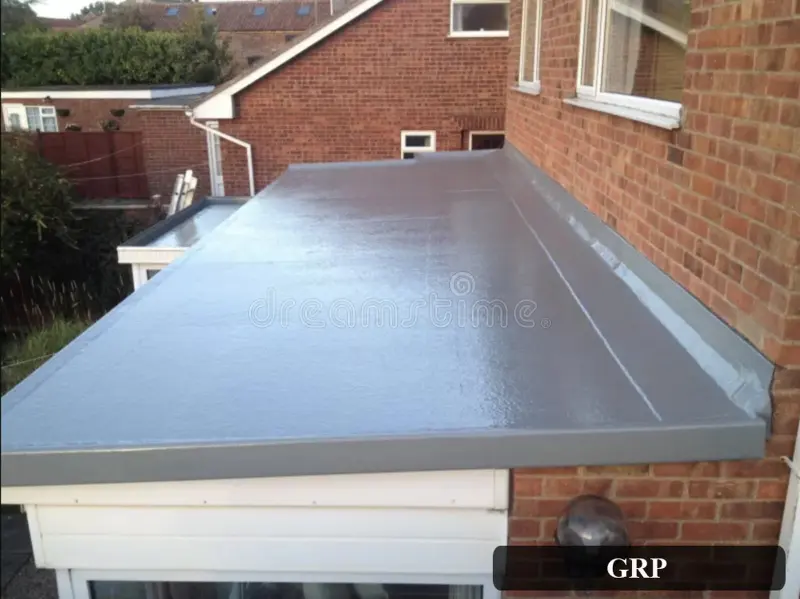
Fibreglass flat roofing — also called GRP (glass reinforced polyester) — creates a hard, seamless surface that's extremely durable and completely waterproof when installed correctly. It's laid as a liquid resin reinforced with fibreglass matting, curing to form a single rigid shell with no joins. This makes it particularly effective on roofs with complex shapes, penetrations, or upstands. GRP is resistant to foot traffic, doesn't support moss or algae growth as readily as felt, and typically lasts 25–40 years. The main limitation is that fibreglass is rigid — on roofs with significant thermal movement or structural flex, it can crack at stress points over time. It's also sensitive to temperature during installation, which requires careful scheduling in Irish weather conditions.
Felt — Torch-On Bitumen
Felt — specifically modern torch-on bitumen felt — is the traditional flat roofing material and still widely used across Dublin. It involves layers of bitumen-based membrane applied with a blowtorch, bonding each layer to the one below. Modern torch-on felt systems are significantly better than the old felt rolls of previous decades and can provide a reliable roof for 15–25 years when properly installed. The main drawbacks are lifespan compared to EPDM and GRP, and the fact that felt is more susceptible to UV degradation over time — the top surface gradually dries out and cracks, eventually allowing water ingress. It's also the material most likely to be found on older Dublin properties that need replacing rather than repairing. That said, torch-on felt remains a solid, cost-effective option for straightforward flat roof jobs when installed by an experienced contractor.
Which is Best for Dublin?
Dublin's climate — persistent dampness, frequent freeze-thaw cycles, and moderate but regular UV exposure — puts specific demands on flat roofing materials. Based on what we see day-to-day across the city and county, here's our honest assessment:
EPDM is our first recommendation for most Dublin flat roof replacements. The combination of flexibility, lifespan, minimal seams, and resistance to Ireland's damp conditions makes it the most reliable long-term performer. For homeowners who want a flat roof they won't need to think about for decades, EPDM is the material of choice.
GRP fibreglass is the best option for complex shapes or where a hard, walkable surface is needed — for example, a flat roof that doubles as a balcony or terrace, or a roof with multiple penetrations for VELUX windows, vents, or soil pipes. The seamless rigid shell handles these details better than any other material.
Torch-on felt remains a practical, reliable option for straightforward garage roofs and smaller extensions where budget is a consideration. It performs well when properly installed and is a legitimate choice — not a compromise — in the right context.
The honest answer is that the right material depends on the specific roof: its size, shape, structural condition, what's above and below it, and how long you want it to last. A flat roof isn't a decision to make based on a quote alone — it needs a proper assessment first. At Hi Performance Roofing, we'll tell you clearly what we'd recommend and why before any work begins.